

How To Tag Files In Windows 10
This quite lengthy article explains and discusses the built-in file tagging implementation of Microsoft Windows x. I practice have a strong background with PIM and tagging and this article is written from the man perspective when manually tagging user-generated files. Please do read my general recommendations on using tags in an efficient fashion.
To my knowledge, Microsoft is currently not actively promoting this characteristic. Therefore, complaining on bad design decisions does not utilize here equally long as Microsoft does non understand this kind of tagging as something which was designed to be used by the general user. Because from my perspective, it obviously tin can't exist meant to be used in practise. Unfortunately. Let'south accept a closer wait why I came to this conclusion.
TL;DR: Microsoft Windows does provide NTFS features to tag arbitrary files. Some applications do also merge format-specific tags with these NTFS tags. Although there are quite nice retrieval functions for tags, information technology is very complicated to use this for general file direction. Applied tags are easily lost so that in practice, users will refrain from using native Windows file tagging like this.
Table of contents:
- What Does Tagging Mean Here?
- A Well-Subconscious Feature
- How to See and Assign Tags
- How to Make Use of Tags
- Playing Around With Tags
- Enabled File Types for Tagging
- How to Enable Tags for More than File Types
- Relations Betwixt Applications and Meta-Data
- History, Implementation Details, and Similar Implementations
- Windows 10 Tags Considered as Frail
- Summary and Remarks
What Does Tagging Mean Hither?
For this article, I am talking about not-collaborative local file-tagging. This describes the process of attaching one or more than unique keywords to files stored on NTFS file systems by users who are able to access the file with granted write-permissions via the Windows File Explorer. "Keywords" and "tags" are used equally synonyms here.
I could elaborate on tag and tag-arrangement definitions for quite some time but permit us terminate hither for the sake of brevity. Information technology will be a long journey after all.
A Well-Hidden Characteristic
Past default, the Windows UI does not expose annihilation at all that would help the users to recognize the file tagging possibility. So nosotros practice have a more or less full back up for tagging files and all the same Microsoft hides this quite well from the mutual eye. Probably for a good reason, which nosotros are going to find out below.

Although I'm very interested in topics related to tagging this feature is that well subconscious so that I was not aware of this feature myself until I read about it in a volume in 2018. Support for tagging started as early as with Windows Vista.
How to See and Assign Tags
In club to run across and edit file tags, you accept to enable "View (Tab) → Details pane" in the File Explorer.

At that place is a second UI feature you might want to activate: the read-only Tags column is activated past choosing "Tags" in the context menu of the column bar:

When you become through different files, you volition recognize that not all file types can be tagged by default. For instance, the details pane for a simple text file does non show the "Tags: Add a tag" in contrast to whatsoever JPEG image file as shown in the screen-shots to a higher place.

Assigned tags are visible in the details pane likewise every bit in the tags column:

Adding or modifying tags is possible in the Details pane but not in the tags column. You will recognize that Microsoft allows tags with spaces and special characters. Multiple tags are usually separated by semicolons which is probably the only standard character which is non allowed inside tags.
The terminal identify where File Explorer is showing y'all the assigned tags and as well allows to edit them is inside the Properties of a file:

As shown in the screenshots above, tags might be added/removed/modified at two places: either on the "Details pane" (on the right mitt side of the File Explorer window) or inside the file properties on its "Details" tab.
How to Make Use of Tags
At present that we accept tagged some files, what possibilities are in that location to utilize this meta-information in daily life? First of all, in that location is navigation. For navigating through your files, you might adopt your File Explorer sorted alphabetically by file name:
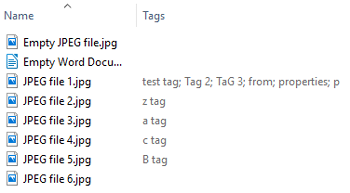
With tags, you might too sort alphabetically by tags instead:
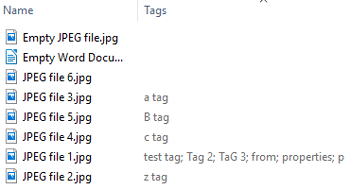
Since the order of files in the "sorted by tags"-view is depending on the club of tags inside the files, I do not consider this a great improvement. Even so, what is actually neat is when you consider the "Grouping by"-method. Exist default, File Explorer is grouping by names:
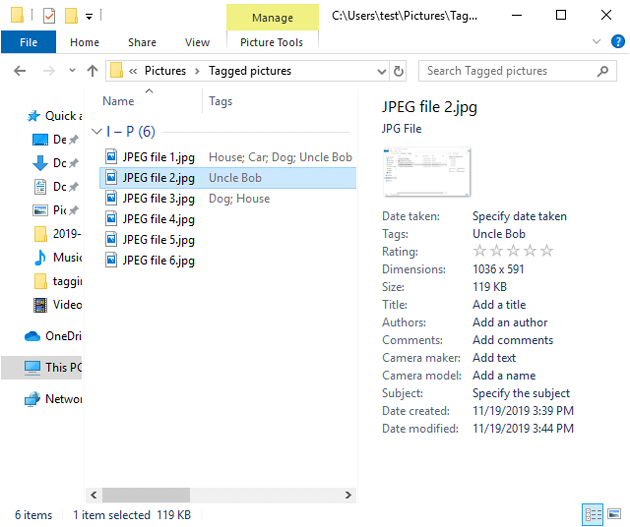
You can alter the grouping in the "View" tab of the File Explorer:
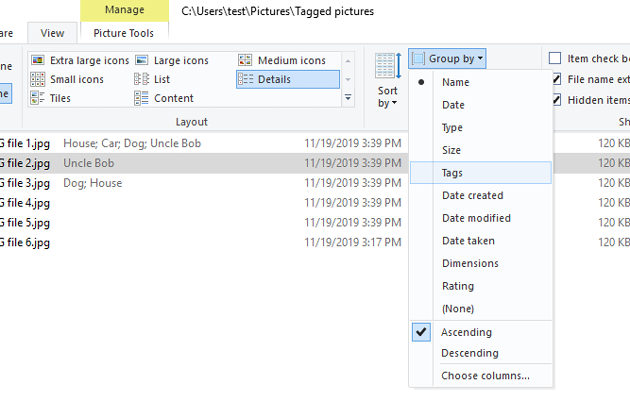
Having switched to "Group by Tags", you will find that all files are bundled past their assigned tags:
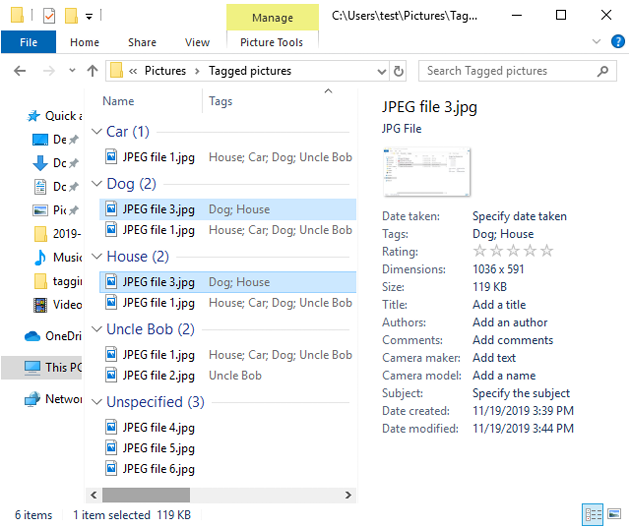
Untagged files are listed in the "Unspecified" category at the bottom. The categories in a higher place correspond to the alphabetically sorted list of tags. Each file is listed in one case for each tag. So if a file like JPEG file 3.jpg does accept ii different tags ("Dogs" and "Business firm"), it is listed twice. One fourth dimension in the category "Dogs" and i time in the category "House". If you select it in one category, this single file gets selected in all categories.
Complementary to file navigation, File Explorer has a search characteristic implemented. The following image shows the result when yous exercise search for a tag "house" inside the binder we've used above:
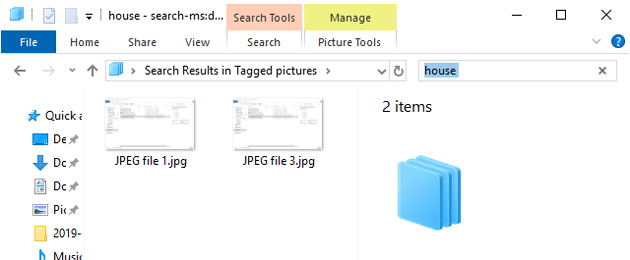
You will notice that all files are listed in the results that do characteristic the tag "house" or "House". So search as well as "Group by Tags" is case insensitive when it comes to tags. All other files, not having the "firm" tag, are omitted.
When you search for multiple tags, just the files that do contain all of them are listed:
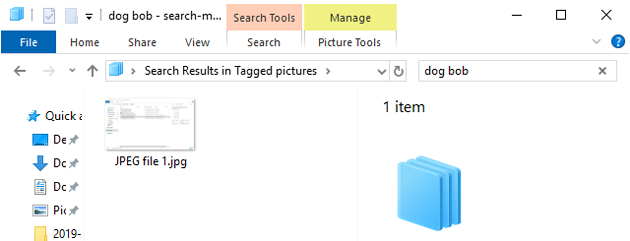
On the negative side, y'all can not search for keywords that only occur within tags. I would have expected a query language according to the widespread design like "tag:dog" which would wait for the occurrence of "domestic dog" but just within the tags and not the file name or the content.
So if yous're searching for "dog", you will find files that incorporate the tag dog also every bit files that do contain "dog" inside their file name:

This File Explorer tag search is not a sub-string search: if you lot want to discover files tagged with "mydog", you can not observe them past searching for "dog". Nevertheless, when you have tagged files with "my dog", you will find them in the search results for "domestic dog" only not within search results for "dogs".
In summary: Searching for tags is:
- case-insensitive,
- not-sub-string,
- whole-give-and-take and not whole-tag.
Playing Effectually With Tags
When you play around with dissimilar tags, yous volition discover out that this feature is intended to exist used case-insensitive. When y'all tag a file with "Canis familiaris" and "dog", the final i wins and the other gets removed.
When "Adapt past Tags" is used, the tag "Dog" every bit well every bit "domestic dog" gets listed in the category "Dog".
When you lot select multiple tagged files, the Details pane shows only the tags that can be institute within all selected files. The other ones are not visualized. Yous may add additional tags which then gets added to all selected files:

You may remove all tags of one or a set of selected files with "Properties → Details → Remove ...".
This folio mentions a context bill of fare function to export the meta-data of selected files to an xml file. Meta-data from an xml file could be applied to the files every bit well. I was non able to find this function in my tests.
Enabled File Types for Tagging
In the previous sections I mentioned briefly that merely a sub-set of file types may be tagged by default. In my opinion, this is a very tough restriction if you want to use tags for organizing your files.
On a fresh Windows 10 installation, in that location are not even a hundred file types that may exist tagged. When apps become installed like Microsoft Office or LibreOffice, meta-information handlers for additional file formats gets added and configured. On my business organization Windows 10 organisation approximately 180 extensions had associated meta-data handlers. Afterwards installing LibreOffice on a Windows ten virtual auto, about 120 extensions were listed as tag-able, approximately xxx of them from LibreOffice alone. I noticed that LibreOffice does not create meta-data handlers for Microsoft formats such equally .docx or .xlsx whereas handler for older formats are created: .medico or .xls.
Information technology is important to know that not all meta-data handlers offer meta-data tagging past keywords. Just meta-information handlers that contain definitions for "System.Keywords" issue in the ability to exist tagged. Furthermore, not all meta-data handlers that contains keywords/tags offer them also in file properties.
I tried to come up with a minimum list of activated tagging via meta-information handlers. When downloading a fresh Windows 10 virtual machine similar that one, you will find some tools pre-installed. In this example, these are many development tools. Later manually installing DotNet, LibreOffice 5.4.iv, pigment.net 4.2.five, all extensions with enabled handlers for keywords/tags are:
.asf .cr2 .crw .dng .doc .dot .dvr-ms .erf .flac .jfif .jpe .jpeg .jpg .jxr .kdc .m1v .m2t .m2ts .m2v .m4a .m4b .m4p .m4v .mka .mkv .mod .mov .mp2 .mp2v .mp4 .mp4v .mp3 .mpeg .mpg .mpv2 .mrw .msi .msp .mts .nef .nrw .pef .raf .raw .rw2 .rwl .sr2 .srw .tif .tiff .tod .ts .tts .uvu .vob .wdp .weba .webm .wma .wmv
I did non mention all well-known LibreOffice formats that were also in the list.
As you can encounter, most of these activated file types do not reflect bug relevance for the average user. Selected extensions that do not have handlers or no handlers that provide tagging:
.avi .docx .exe .gif .lnk .mp3 .png .wav .css .csv .epub .gz .html .json .coffee .txt .wmf .xhtml .xlsx .nada
Therefore, there are many file types which may be used on whatever given Windows machine that can non exist tagged by default.
How to Enable Tags for More than File Types
Later on we have found out that it would be overnice to have more than file formats enabled for tagging, how are nosotros able to enable meta-information handlers ourselves?

The answer lies inside a project called FileMeta. Yous can download the latest release on their release page. Installing this tool requires administration permissions. I totally recommend the documentation pages for learning about details on this topic in general.
After installing FileMeta, you will detect multiple executables in its install directory: FileMeta.exe, FileMetaAssoc.exe and FileAssociationManager.exe.
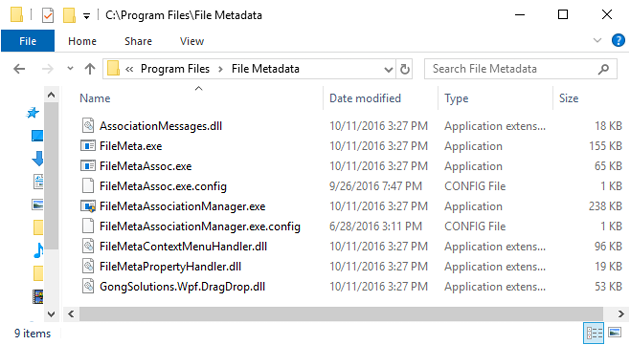
Near things can also be done on the command line. For configuring the tagging functionality, we'll stick to the graphical FileAssociationManager.exe for this commodity. After starting up the File Meta Association Manager you volition run into three primary parts of the UI:
- Some workflows for manipulating on the left hand side,
- the File Extensions list with the handler associations and
- the meta-data related settings on the right hand side:

Extending the List of File Extensions
The listing of the file extensions are read from the Windows registry. If you can non discover a specific file extension in the File Meta Clan Director, no application has registered the file extension then far. If you do associate a file extension with an application ("Always open up with ..."), this does not create a registry entry. Therefore, associating an extension with an awarding is not sufficient that this extension gets listed in the File Meta Association Manager.
To add an extension not listed yet, y'all have to outset the registry editor with administrator privileges, go to "HKEY_LOCAL_MACHINE" → "SOFTWARE" → "Classes" and choose "New → Key" from the context bill of fare.

And then you can enter your new extension like, e.g., .org and ostend with the return key. Subsequently restarting the File Meta Association Managing director y'all'll notice the new extension in the list.
Pre-Defined Profiles
My File Meta Clan Manager lists ii pre-divers profiles: "Simple" and "OfficeDSOfile". The latter seems to be set up by LibreOffice. The "Simple" profile has a few backdrop fix up for "Preview Panel", "Details tab in Backdrop" and "Info Tip":

Custom Profiles
If you would like to fix upwards a new custom profile, y'all have to know:
- Full details → Clarification "System.Keywords": necessary to run across and edit tags in the preferences → Details tab.
- The Preview Panel → "System.Keywords": necessary to come across and edit tags in the Details pane.
You can't have Details pane without preferences Details tab. Both settings enable the tags shown in the column bar.

Therefore, a minimal custom contour for tagging where y'all can see the tags in the Details tab looks like that:

Such a profile results in a File Explorer view like that, where y'all can edit tags in the preferences likewise as in the Details tab:

Whenever y'all modify meta-data handlers, you will probably going to restart the File Explorer via the "Restart Explorer" button of the File Meta Clan Director in gild to utilize changes.
After setting upward a custom meta-data handler for file extensions, yous tin see them as well in the command line tool FileMetaAssoc.exe:
c:\Program Files\File Metadata>FileMetaAssoc.exe -l .txt Uncomplicated File Meta Belongings Handler c:\Program Files\File Metadata>
Relations Between Applications and Meta-Data
As mentioned briefly before, some applications do create meta-information handlers for file extensions when being installed. For case, LibreOffice is creating handlers for their document formats as well as some formats from Microsoft such equally .physician or .xls but not .docx or .xlsx.
Programs like LibreOffice Writer or Microsoft Word do provide meta-information within the preferences of an open document.

Y'all are able to enter tags within the certificate properties:

These tags can now be seen in the file properties (Details tab) likewise equally in the tags cavalcade. Considering of the missing "Organization.Keywords" in the profile for the "Preview Console", the tags are not shown in the Details tab of the File Explorer:

Hither is the File Meta Association Managing director profile "LibreOffice property handler" as set upward by LibreOffice:

It'due south interesting to see that the "LibreOffice property handler" is non visible in the File Meta Association Manager profiles. So I tried to overwrite the "LibreOffice property handler" with the "Elementary" profile. To my surprise, this happened:

Yep, this makes sense after all. After confirming this dialogue, the File Meta Association Managing director window was gone. I thought that this action was not successful and the app crashed. After restarting the application, I noticed the successfully merged profiles for the .odt extension.
Unfortunately, in contrast to my expectations, at that place was no change: no tags visible in Preview page of File Explorer and tags in Details tab tin can not be changed, just viewed. Then this was not a success later all: I still can non modify tags for LibreOffice Author files exterior of LibreOffice Writer file preferences although they tin be seen in File Explorer.
So I started to create some non-native LibreOffice Writer documents: .doc and .docx. For .docx files, there were no document holding tags visible in File Explorer: not in Preview pane, not in tags column and non in the file properties.
Different story with the .physician files though: Here, the document property tags are synchronized with the NTFS meta-data. Whenever a tag is added or changed in the file properties, the aforementioned alter appears in the LibreOffice Writer document backdrop and vice versa. Yet, at that place are no tags/keywords visible in the Preview pane.
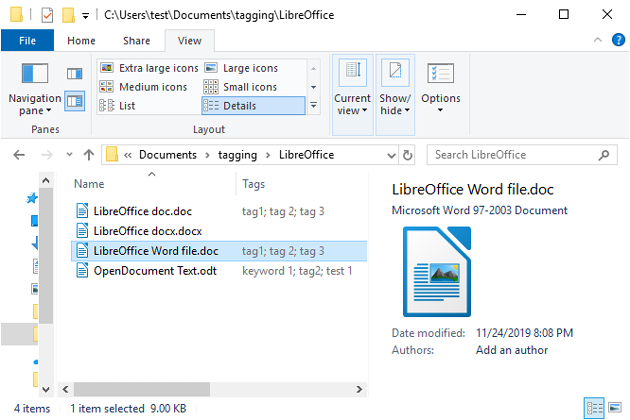
This tag synchronization mechanism has a pocket-sized consequence: when you lot do not create a .md file from within LibreOffice Writer or Microsoft Word only with a text editor, there is no inside-file meta-data preferences yet. This results in an mistake message when y'all desire to tag a zero byte .doc file in File Explorer:

When you do select "New → Excel Spreadsheet" in File Explorer with Microsoft Office installed, it does not create a cipher byte file as with Discussion files using the same method. Instead, information technology fills the spreadsheet file with a seven kilobyte default content. This way, you won't go this error bulletin for Excel files in this state of affairs.
Related to this, y'all tin read on the FileMeta FAQ for PDF files:
If I add the File Meta Holding Handler for PDF files, will I run into properties already in those files? No, unless yous are using version 1.4 and are extending an existing property handler for PDF files. File Meta has no capability otherwise for reading properties held within the PDF formatted part of the file. File Meta always writes properties in an NTFS-provided annex to the file. [...] The bad news is that File Meta before version 1.4 will not read backdrop held in the type-specific formatted part of a file, and no version of File Meta will update such properties.
To make this even more complicated, you accept to know that Windows supports tags for every file type, internally. They will not be visible in the properties section of that file, merely when you lot search for those tags, the file appears in search results.
After all these experiences I tin only sum up my experience with: information technology'due south very complicated. The end-user tin can not look tags/keywords to be visible in the File Explorer. She is not able to know if document preference keywords are synchronized to the NTFS meta-data. If there are tags visible, they may non be able to be managed on the Preview pane or the file preferences. File Explorer search seems to find all keywords so far. Still, you don't know that a specific file was constitute because of a tag or anything else since this visualization is missing.
History, Implementation Details, and Similar Implementations
You can read near the history of this feature and some technical details on this page. Basically, NTFS stores the meta-data within an Alternate data streams (ADS). This is quite similar to how Apple stored meta-information in HFS+ and probably besides within AFS. I was using the color labels of Os Ten up to Leopard. They ended upwardly as file-organisation based meta-data also.
You can read on this Wikipedia article:
In Apple's macOS, the operating system has allowed users to assign multiple arbitrary tags as extended file attributes to any file or folder e'er since OS X 10.9 was released in 2013, and before that time the open-source OpenMeta standard provided similar tagging functionality in macOS.
Windows x Tags Considered every bit Fragile
I do remember that the average reader does agree that using tags with this Windows 10 characteristic is a elevate from the user experience point of view already. I do have sorry news: this now even gets worse.
Since meta-data are stored in NTFS data streams, you are losing all of the tags when files get moved to someplace where there are no NTFS data streams or when applications generating files exercise not respect them properly. As a consequence, at that place are many possibilities where meta-data gets lost. Here is a list of the most obvious ones.
- Losing meta-data when copying to a thumb drive
- Copying a tagged file to a drive that is non formatted with NTFS results in a silent loss of the meta-information. Thumb drives usually are formatted with FAT32.
- Losing meta-information when sending them via e-mail
- When yous attach a tagged file to an e-mail, the meta-data does non get attached as well.
- Losing meta-data because of applications handling temporary files
- When you lot open a file in too many Windows applications, new modifications by the user get written to a temporary file. On saving the changes to the file, this temporary file then gets renamed to the original file name, overwriting the previous file as well as the meta-data. This is a very mean behavior since users would never look to lose meta-data just past saving a file.
- Losing meta-data when doing backup
- When you back up your information, the backup application needs to relieve and restore meta-data within ADS properly. I did not investigate this issue merely my gut feelings are that only a fraction of the tools on the market do consider ADS meta-data and handle them accordingly.
Summary and Remarks
Later being enthusiastic when I found out that Microsoft provides a native file tagging ecosystem with Windows, I had to take a closer look. This enthusiasm was replaced by a disillusion. Everything related to file tagging is hidden from the common user by default. Enabling it results in transmission labor not only for the UI but too for each and every file extension separately. Although there are some nice retrieval features for navigation, search does not differ betwixt keywords in tags and keywords anywhere else. It is not entirely clear to me how file-format-specific tags interact with the NTFS tags. Finally, when you did invest some time for tagging files, there is a high take a chance of losing all this meta-information sometimes without even realizing it.
If Microsoft would act in a way that somebody would be thinking that this tagging characteristic is ready for production, information technology would qualify for my bad design decisions series. For me personally, I'd never invest annihilation in using this feature mainly because of the many ways of losing meta-information without noticing. My current approach for tagging is described on this commodity. It's an Bone-contained and app-independent method with very nice features like TagTrees you can not observe elsewhere.
If you lot would similar to become an overview on other non-file-organization-based tagging solutions, y'all tin read the bachelor thesis "Marktübersicht von Tagging-Werkzeugen und Vergleich mit tagstore" which can be downloaded at the tagstore folio. Information technology'due south in German language and information technology reflects the situation of the year 2013.
Before writing this article I needed to implement a necessary characteristic for my blogging system beforehand. With this, you lot are now able to click on the screenshot previews to see them with their original size. So this article was in my personal pipe-line for over a year. As a issue, early findings and screen shots from 2018 are based on Windows x Pro version 1803 Os build 17134.165 whereas the most electric current ones from 2019 are based on Windows ten Enterprise Evaluation 1809 Os build 17763.805.
Congratulations for following this very long blog article until its cease. I hope I could teach you lot something on Windows 10 functions and assist you decide on its usefulness for your situation. Drop me a line in the comments below when you do have some questions or remarks.

How To Tag Files In Windows 10,
Source: https://karl-voit.at/2019/11/26/Tagging-Files-With-Windows-10/
Posted by: lemenmaress61.blogspot.com
0 Response to "How To Tag Files In Windows 10"
Post a Comment